
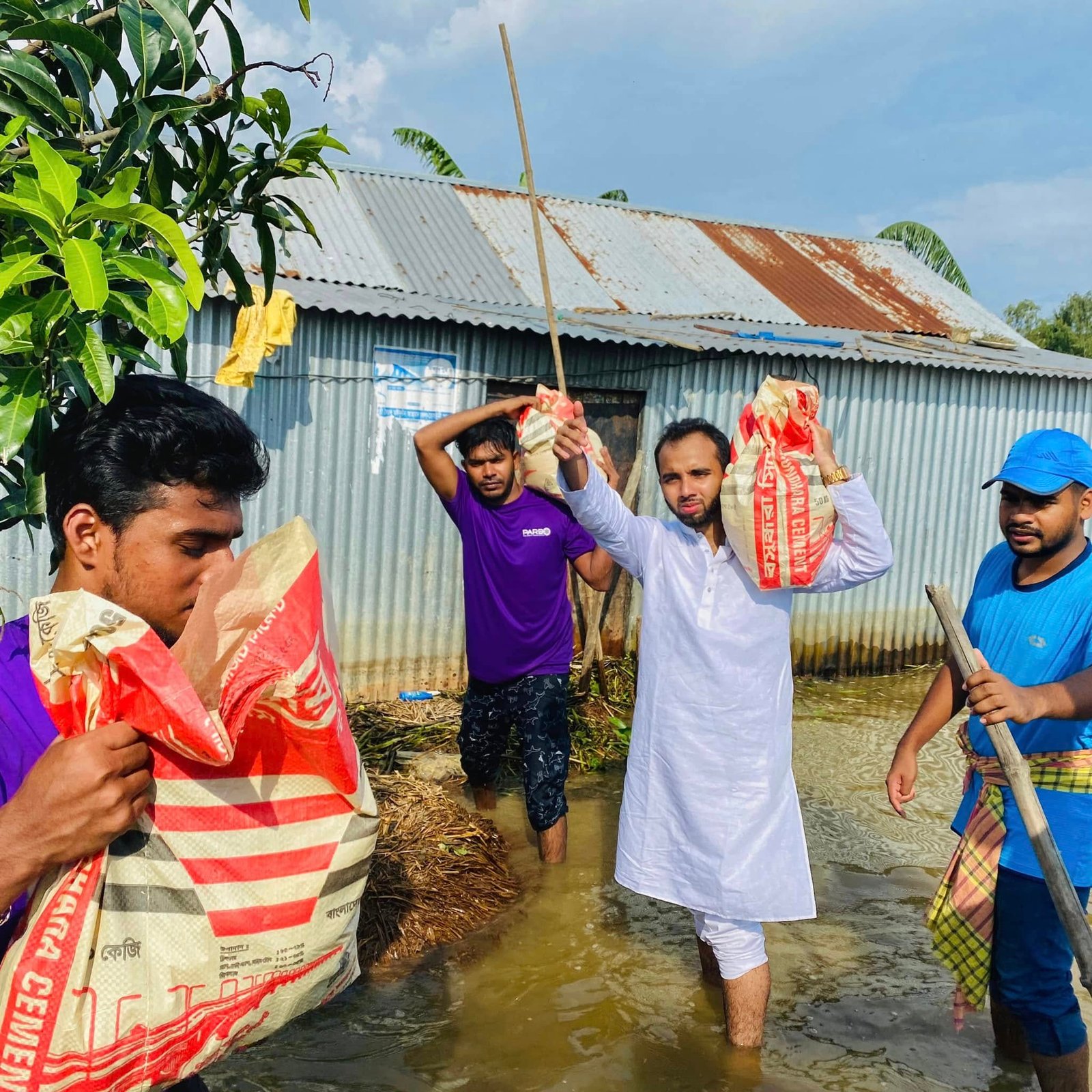
Disaster relief in Bangladesh became very personal to me during the 2022 flood.
Through Parbo Foundation, I had the opportunity to take part in relief activities for people affected by the disaster. Before that experience, I had seen poverty, read about floods, and heard stories about families losing their homes and belongings.
But seeing it closely was completely different.
That experience changed the way I understand poverty, crisis, and social responsibility.
Understanding Disaster Relief in Bangladesh Differently

When we live in cities, a flood can sometimes feel like another piece of news.
We see photographs, watch videos, and read statistics.
But behind every number there is a family.
There is a mother worried about feeding her children. There is an elderly person who cannot move easily. There is a farmer watching the result of months of hard work disappear under water.
During our 2022 flood relief work, I understood that disaster is never only about water.
It affects food, shelter, income, education, health, and people’s sense of security at the same time.
The Struggle of People in the Vati Areas
One of the things that stayed with me most was the suffering of people living in the vati areas, the low-lying parts of Bangladesh that are naturally more vulnerable to flooding.
For many of us, heavy rain is an inconvenience.
For some of these families, it can change their entire life.
When water rises, roads disappear. Homes become difficult to live in. Work stops. Food becomes harder to find. Reaching a doctor or buying basic necessities can become a serious challenge.
What surprised me most was how people continued to survive despite having so little.
Their lives taught me something that no book could teach.
Relief Is About More Than Giving Food
During a crisis, emergency food and essential supplies are extremely important.
But disaster relief in Bangladesh also taught me that helping people is not simply about handing over a relief package.
You have to understand what they actually need.
You have to reach people who may be far from the easiest locations. You have to organise properly. You have to make decisions quickly because, during an emergency, time matters.
Most importantly, you have to treat people with dignity.
A person receiving help is not less important than the person giving it.
Poverty Looks Different When You See It Closely
The 2022 flood also changed my understanding of privilege.
Many things that I consider normal—clean water, dry clothes, transportation, electricity, food at home—can become luxuries during a disaster.
It made me think about how differently people experience the same country.
Some people can recover from a crisis within days.
Others may spend months rebuilding what they lost.
That difference matters.
Crisis Management Requires Preparation
Another important lesson was that good intentions alone are not enough.
Emergency work requires planning.
You need volunteers, transportation, communication, proper distribution, and an understanding of where help is most urgently needed.
This experience taught me that effective social work should combine compassion with organisation.
Without compassion, relief work becomes mechanical.
Without organisation, compassion may not reach the people who need it most.
What the 2022 Flood Left With Me
My work with Parbo Foundation during the 2022 flood was only one small effort compared with the scale of the disaster.
But personally, it taught me a lot.
It taught me to look beyond statistics.
It taught me how difficult life can be for people living in vulnerable parts of our country.
And it reminded me why social impact matters.
We may not be able to prevent every disaster.
But when people are facing their hardest days, we can choose not to look away.
Sometimes social work begins with something very simple:
being present when people need us most.